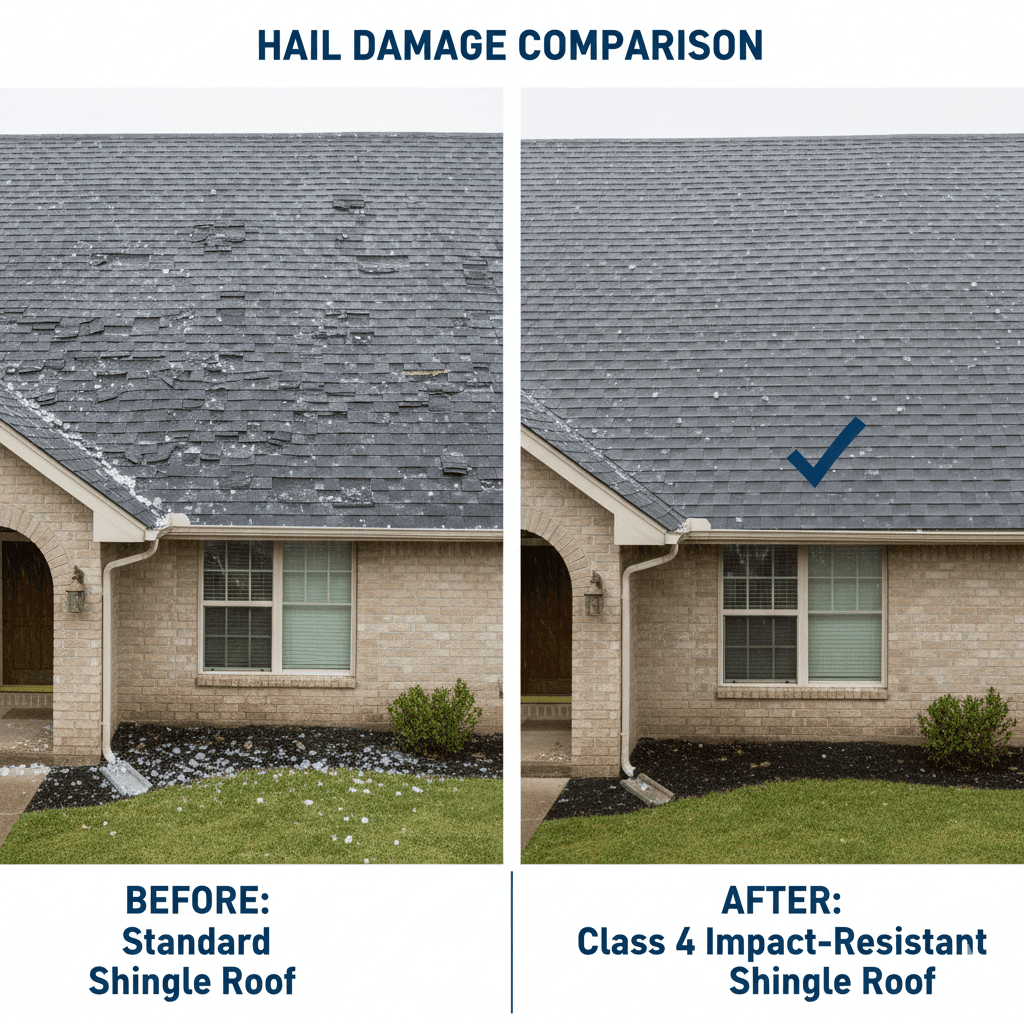
Hail gets all the attention in Central Texas roofing conversations. And for good reason — Williamson County is in a well-documented hail corridor, and a significant hail event can total a roof in minutes. But wind damage to roofs is actually more common, more widespread, and in many cases more insidious than hail damage. Wind damage can develop over multiple storm events, go unnoticed for months or years, and cause interior water damage long before the roof shows obvious exterior failure.
Taylor, TX sits in an area where wind events arrive in several forms: the violent thunderstorm outflows that accompany supercell storms moving off the Hill Country in spring, the occasional straight-line wind event (derecho) that can push sustained 70–80 mph winds across Williamson County, and the tropical moisture intrusions from the Gulf that bring not just rain but wind in the 40–60 mph range. None of these are tornado events — they're the run-of-the-mill storm catalog for Central Texas, and they're hard on roofs.
This guide covers what wind actually does to roofs in Taylor, how to identify wind damage from the ground, what separates wind damage claims from hail claims, and how to navigate the repair process without making costly mistakes.
Williamson County Wind Events: The Context for Taylor Homeowners
Before getting into roof specifics, it helps to understand the wind environment Taylor homes actually face.
Thunderstorm outflows and microbursts are the most common source of significant wind damage in Williamson County. As a large thunderstorm reaches maturity, the cold air column within the storm collapses downward, spreading outward at the surface. These outflow boundaries can generate winds exceeding 60 mph in a very localized area for a very short time — often less than 5 minutes. A homeowner two streets away may experience mild rain; a home directly under the outflow boundary takes a 65 mph punch. This is why wind damage claims in Taylor often follow a pattern: some houses on a block have significant roof damage, adjacent houses have none.
Derechos are less frequent but more widespread. A derecho is a long-lived, bow-shaped storm system that moves rapidly across a region, producing damaging winds over a path that can stretch hundreds of miles. Central Texas has experienced multiple derechos in the last decade, producing wind events in the 60–80 mph range sustained over wide areas. These events damage roofs across entire neighborhoods simultaneously — and create the post-storm rush for contractors that benefits storm chasers and disadvantages homeowners who don't know who to call.
Tropical moisture events from the Gulf of Mexico bring extended rain with sustained winds in the 30–50 mph range. These events don't produce the dramatic single-gust damage of thunderstorm outflows, but they stress roofing systems over many hours — particularly shingles and flashings that are already aging and beginning to fail. A roof that would have held up for another two years in normal conditions may fail during an 8-hour tropical rain event.
Winter storms, less frequent in Taylor than in North Texas but not unknown, bring ice loading and occasional high winds that stress already cold and brittle shingle material differently than warm-weather wind events.
What Wind Actually Does to Roofs in Taylor TX
Wind doesn't damage all roofing the same way. The mechanism matters for understanding what repairs are needed and how to document damage for insurance.
Lifted and Creased Shingles
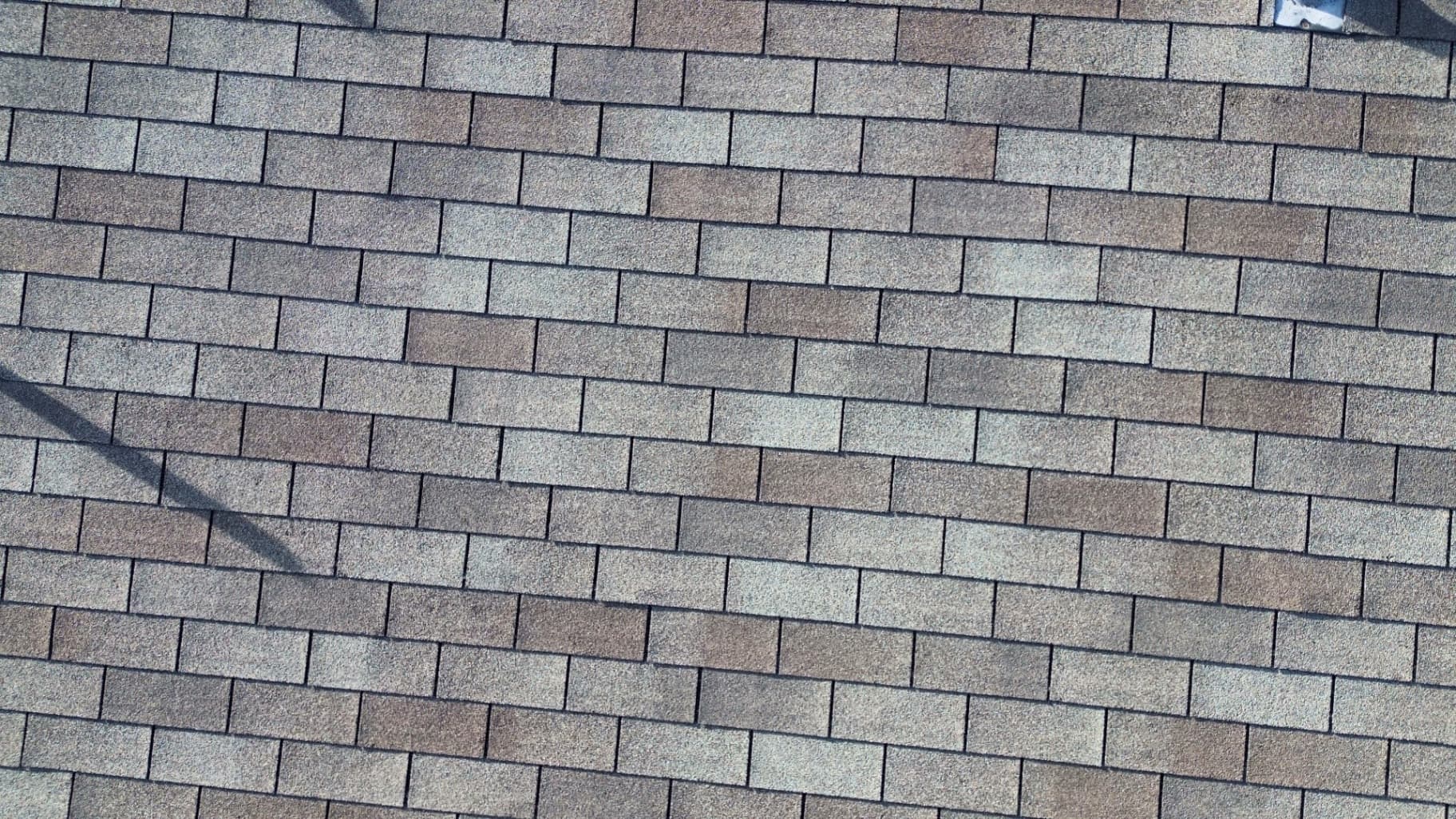
Asphalt shingles have a self-sealing strip — a line of modified asphalt adhesive along the bottom edge that bonds the shingle to the course below it. In normal conditions, this seal keeps shingles locked down against wind uplift. As shingles age, the seal strip becomes brittle and less adhesive. UV, thermal cycling, and simple time all degrade the bond.
When wind gets under a shingle with a weakened seal strip, it lifts the shingle upward. If the wind gusts and releases, the shingle snaps back down — but now it's creased. A creased shingle has a fracture line across the mat that will eventually become a crack, water infiltration point, and source of ongoing damage. Creased shingles are one of the most commonly missed forms of wind damage because from the ground they look intact — the shingle is down and in position. Only from roof level (or with quality binoculars) can you see the crease.
Blown-Off Shingles and Sections
More obvious than creasing, blown-off shingles leave visible gaps in the roof surface. If you can see dark patches on your roof after a storm where you previously saw shingles, blown-off material is the explanation. Even a small gap — one missing shingle — is sufficient for water to enter the roof assembly under sustained rain.
The pattern of blown-off shingles tells a story. Missing shingles near the eaves suggest the wind got underneath from below. Missing shingles at the ridge suggest the wind overtop the peak and peeled from above. Missing shingles in mid-field, with adjacent shingles intact, often points to a pre-existing spot of weak adhesion or previous repair work that failed under wind load.
Ridge Cap Loss
The ridge cap is a line of folded shingles (or a purpose-made hip-and-ridge product) that covers the peak where two roof planes meet. Ridge caps are among the first elements to fail in high winds because they're fully exposed to wind from all directions and receive wind uplift from both sides simultaneously. A missing ridge cap is a significant leak point — water gets into the ridge and runs down the decking before eventually finding interior penetration points.
Ridge cap loss after a wind event is common enough that it's sometimes the only damage on an otherwise intact roof. Don't assume that because most of the shingles are still in place, the roof is fine — check the ridge specifically.
Flashing Displacement
Metal flashings seal the transitions between roofing materials and roof penetrations: around chimneys, at pipe boots, along walls where the roof abuts a vertical surface (step flashing), and in valleys. These flashings are held in place by a combination of nailing, sealing, and in some cases the weight of overlapping materials. Wind events can separate flashings from their substrate, particularly at chimneys and at headwall flashings where the roof meets a vertical wall.
Displaced flashing is a serious damage type because it creates an immediate water infiltration point that may not produce interior symptoms for weeks or months — the water enters, runs along the decking or framing, and eventually finds a path to living space at a point distant from where it entered. By the time a homeowner sees a stain on the ceiling, the framing and insulation may have been wet for months.
Soffit and Fascia Damage
Wind-driven rain is particularly hard on soffit and fascia. The fascia (the board that runs along the edge of the roof, visible from the ground) and the soffit (the underside of the roof overhang) are exposed to horizontal rain in ways that the roof surface isn't. Fascia boards swell and rot when repeatedly soaked. Soffit panels are frequently blown in or cracked during high-wind events — particularly the vinyl soffit common in mid-century Taylor homes.
Damaged soffit creates a pathway for water and wind into the attic space. Damaged fascia eventually causes gutters to separate from the home when the rotted wood can no longer hold hangers.
Tree and Limb Impacts
Taylor has significant tree canopy — live oak, red oak, cedar elm, and pecan are common in residential areas. Wind events bring down limbs (and occasionally entire trees) onto roofs. The damage spectrum here is wide: a small limb might do nothing more than scratch shingles; a large limb can puncture the decking; a full tree fall can be catastrophic structural damage.
Tree impact damage is typically the most visible and most urgent category of wind damage. It's also the most likely to result in homeowner action — because you can see it. The categories above (creasing, flashing displacement, ridge cap loss) are much easier to miss.
How to Identify Wind Damage From the Ground
The first instinct after a storm is to climb up on the roof and look. Don't. Wet roofs are slippery, and the adrenaline of a storm event is not the right moment for a ladder. You can assess a significant portion of wind damage risk from the ground with a basic visual inspection.
What to look for from the ground:
- Shingle tabs hanging or curled: If you can see shingle edges flapping or standing up from the eave line, seal strip failure is occurring.
- Missing sections: Dark patches or visible decking where you should see shingles.
- Ridge disruption: The ridgeline should be continuous and straight. Gaps, missing caps, or irregular texture along the ridge indicate damage.
- Debris pattern around the house: Shingle granules, asphalt mat pieces, or sections of shingle material in your gutters or around the perimeter are evidence of shingle damage even if you can't see the damage from the ground.
- Gutter deformation: Gutters bent inward, hanging away from the fascia, or showing impact marks from debris.
- Fascia staining: Waterfall marks on the fascia below the gutter line, or paint peeling, suggest the gutters are overflowing or water is bypassing the gutter system.
The binoculars approach: A pair of 8x or 10x binoculars lets you look at ridge lines, chimney flashings, and individual shingle conditions that aren't visible to the naked eye from street level. If you're going to invest in any post-storm assessment tool as a homeowner, inexpensive binoculars are the most practical option.
Wind Damage vs Hail Damage: How to Tell the Difference
This distinction matters for insurance claims, because wind damage and hail damage are sometimes handled by different deductibles and different policy provisions.
Hail damage indicators:
- Bruising on shingles (circular soft spots where the mat has been displaced beneath the granules)
- Granule loss in a circular or splatter pattern
- Dings on metal components (gutters, vents, HVAC housing, flashing)
- Damage is typically uniform across the entire roof surface exposed to the storm direction
- Hail damage usually occurs uniformly across a neighborhood — most homes on a block are affected if one is
Wind damage indicators:
- Lifted, creased, or missing shingles — particularly at eaves, ridges, and corners
- Damage concentrated at roof edges and high-exposure areas rather than uniformly distributed
- Flashing separation and displacement
- Soffit/fascia damage
- Tree debris impact marks
- Pattern of damage varies significantly from house to house (some fully exposed, some sheltered by trees or adjacent structures)
A single storm can produce both hail and wind damage simultaneously. When this happens, the inspection needs to document each type separately — they may trigger different provisions or deductibles in your policy.
Documenting Wind Damage for Insurance
Proper documentation before any repair work starts is the foundation of a successful insurance claim for wind damage. If a contractor does emergency tarping or repair before documentation, critical evidence for the adjuster may be gone.
Step 1: Date and time stamp everything. Your phone's camera automatically records metadata. If you use a separate camera, note the date and time. The adjuster will want to confirm that the damage is consistent with the dated storm event.
Step 2: Photograph all exterior damage from the ground. Wide shots establishing context, then close-ups of specific damage. Include reference objects in close-up shots to establish scale (a tape measure, a hand, a familiar object).
Step 3: Document interior symptoms. Water stains on ceilings, wet insulation visible in attic access, watermarks on walls. These support the claim that the exterior damage has caused interior water entry.
Step 4: Note the storm event specifically. Your insurance company's adjuster will check weather records for the date and location. Having the specific storm event, time, and reported wind speeds helps establish the causal connection.
Step 5: Get a contractor inspection before the adjuster visit if possible. A roofing contractor's written inspection report, dated after the storm and before the adjuster visit, creates an independent record of what the roof looked like in the immediate aftermath. Some adjusters arrive weeks after the storm; a documented pre-adjuster inspection prevents disputes about whether additional damage occurred during the wait period.
Emergency Tarping After Wind Damage in Taylor TX
If your roof has an open penetration — missing shingles, displaced flashing, tree impact — tarping protects the interior until permanent repairs can be completed. Done right, a tarp is a temporary bridge. Done wrong, it creates additional problems.
What legitimate emergency tarping looks like:
- Tarp extends at least 3 feet beyond all sides of the damaged area
- Tarp is secured at the ridge (not just draped over it) using either battens screwed through the tarp into the ridge or weighted sandbag lines
- Tarp extends over the ridge and is secured on the downslope side as well, not just the damage side
- All penetrations within the tarped area are covered
- Tarp edges are not simply weighted with boards on the roof surface — this allows wind to get underneath
What to avoid:
- Tarps secured only to the shingles with staples or single-point screws around the perimeter — they blow off in the next wind event
- Tarps that don't extend over the ridge — water runs under the high edge
- Tarps placed by homeowners without roofing experience on active storm days — the time to tarp is when conditions are safe
Most homeowner insurance policies cover emergency tarping as part of the claim. Keep all receipts if you pay a contractor for tarping — submit them with the claim as a covered mitigation expense.
Storm Chasers in Taylor TX: Post-Storm Risk
Taylor's growth has made it an attractive target for out-of-town roofing contractors who follow storm events across Texas. After any significant wind or hail event in Williamson County, crews arrive within 24–48 hours, working door-to-door with high-pressure sales tactics and offering to file claims on your behalf.
This isn't universally bad — some storm-following contractors do legitimate work. But the pressure tactics, lack of local accountability, and unfamiliar warranty structures create real risk for Taylor homeowners.
Red flags to watch for:
- Unsolicited door knock within 24 hours of a storm, before you've had time to assess damage yourself
- Offer to "handle everything" with your insurance company and sign paperwork immediately
- Requests to sign an Assignment of Benefits (AOB) — a form that transfers your insurance claim rights to the contractor
- No local physical address — only an out-of-state number or P.O. box
- No verifiable Certificate of Insurance (Texas has no state roofing license to check instead)
- Pressure to sign before getting other estimates
- Discounts or incentives that require signing today
- Offers to waive your insurance deductible (illegal in Texas)
What to do instead: Call a roofing contractor you've researched in advance — ideally one whose insurance and manufacturer certification you can verify directly, with local Google reviews that predate the storm. If you don't have a contractor in mind, ask neighbors who've recently had roof work done, or contact your insurance agent for a list of preferred contractors.
Repair Process for Common Wind Damage in Taylor TX
Once documentation is complete and an inspection has confirmed the damage scope, repairs can begin.
Creased and lifted shingles: Individual shingles that have been lifted and creased can sometimes be re-secured with roofing cement if the crease hasn't fully fractured the mat. If the mat is cracked through, the shingle needs replacement. Replacement of individual shingles is straightforward on most Taylor homes — the challenge is matching color and texture on roofs more than 5 years old, as color batches change and weathering creates a differential.
Blown-off sections: Missing shingles are replaced in-kind. On roofs with significant age, replacing a section may reveal that the surrounding shingles are also in questionable condition, making a partial replacement a judgment call about long-term value. Your contractor should be upfront about this.
Ridge cap replacement: New ridge cap material is installed after removing any remaining damaged cap and inspecting the ridge board for damage. Standard cap shingles or purpose-built hip-and-ridge products are both appropriate.
Flashing repairs: Displaced step flashing, headwall flashing, and chimney flashing require careful reinstallation — these are the areas where improper repair most often leads to ongoing leaks. Confirm that any flashing repairs include proper sealing with roofing cement or butyl-based flashing tape at all overlap points.
Soffit and fascia: Rotted or cracked fascia is replaced with new material before gutters are reinstalled. Blown-in soffit panels are replaced to restore the attic's thermal barrier and ventilation pathway.
Insurance Claims for Wind Damage in Taylor TX
Wind damage claims have some specific characteristics that differ from hail claims in Texas.
Wind deductibles: Many Texas homeowner policies have a separate "wind and hail" deductible that is higher than the standard all-other-perils deductible. This is increasingly common in Williamson County, where carriers have experienced significant losses from storm events. Your wind and hail deductible may be expressed as a flat dollar amount or as a percentage of the insured value of your home (1%–2% percentage deductibles are common, meaning a $400,000 home has a $4,000–$8,000 deductible for wind and hail events). Read your policy's declarations page carefully — this is one of the most important numbers to know before a storm, not after.
ACV vs RCV policies: Texas carriers increasingly offer Actual Cash Value (ACV) policies rather than Replacement Cost Value (RCV) policies for roofs. An ACV policy pays you the depreciated value of your roof at the time of damage — a 15-year-old roof with a 30-year expected life might be paid at 50% of its replacement cost. An RCV policy pays the full cost to replace the roof with comparable materials. If you don't know which type of policy you have, call your agent before the next storm.
Adjuster timing: Insurance adjusters in Texas can take 2–6 weeks to schedule an inspection after a major storm event that affects a wide area. During that wait, protect the home from additional water entry (tarping) and document any secondary damage that occurs during the delay period. Texas law requires carriers to acknowledge a claim within 15 days and accept or deny within 15 days of receiving all necessary information.
Frequently Asked Questions: Wind Damage Roof Repair in Taylor TX
How do I know if my roof was damaged by wind if there's no obvious missing material? The most common hidden wind damage is shingle creasing — shingles that lifted and came back down, leaving a fracture line across the mat. This is only visible from roof level. After any significant wind event, a professional inspection is the only reliable way to rule out creased shingles and displaced flashings.
Can wind damage happen to a roof that's only a few years old? Yes. While older shingles with degraded seal strips are more vulnerable, even relatively new roofs can sustain wind damage in events exceeding the product's wind rating. Most standard architectural shingles are rated to 110–130 mph; Class H (the highest shingle designation) rates to 150 mph. Thunderstorm outflows can produce localized gusts exceeding these thresholds in narrow impact zones.
Does wind damage automatically mean a full roof replacement? No. Wind damage repairs range from replacing a few shingles to full replacement, depending on the scope of damage. Whether your carrier will offer full replacement vs. partial repair depends on the damage coverage percentage (many carriers trigger replacement when more than 25–30% of the roof is damaged) and the age/condition of the undamaged material.
How long does wind damage repair take? Minor repairs (a few shingles, ridge cap replacement) can often be completed in half a day. Larger repairs take 1–2 days. Full replacement triggered by wind damage follows the same timeline as any replacement: typically 1–2 days for a standard Taylor TX home.
My neighbor got a full replacement from insurance but my damage looks similar — why am I only getting a repair? Adjuster discretion and the specific location of damage within the policy's coverage thresholds both play roles. If you believe the adjuster's assessment undervalues the damage, you have the right to request a re-inspection or hire a public adjuster to advocate on your behalf. Public adjusters in Texas typically charge 10–15% of the claim settlement — worthwhile if the claim is large enough to justify the fee.
What if I didn't file a claim right after the storm — can I still file? Texas law gives homeowners one year from the date of loss to file a wind or hail damage claim. However, delayed filing can complicate claims — it's harder to establish the storm date as the cause of damage, and carriers may argue that some of the damage pre-existed the event or occurred in a subsequent storm. File as promptly as you can after discovering damage.
Should I get multiple estimates for wind damage repair? Yes — particularly if the repair scope is significant. Insurance settlements are based on market pricing for materials and labor in your area, and having multiple estimates helps confirm that the adjuster's estimate is consistent with actual local pricing. It also gives you options if your preferred contractor's pricing differs from the estimate.
Can wind damage void my roof warranty? Wind damage itself doesn't void a manufacturer warranty, but improper repair of wind damage might. If your contractor makes repairs using materials or methods inconsistent with the original product's installation specifications, the manufacturer may deny warranty claims for subsequent failures in the repaired area. Use a contractor experienced with your specific roofing product.
Is it worth fixing wind damage on an older roof? This comes down to the repair-vs-replace decision. If the roof is within 5 years of its expected end of life, repairing wind damage may mean spending money on a roof that needs replacement soon anyway. Ask your contractor for a frank assessment of the rest of the roof's condition — a professional inspection alongside the repair assessment gives you the information to make the right call.
Get Wind Damage Roof Repair in Taylor TX
Ripple Roofing serves Taylor, TX and all of Williamson County. We're a CertainTeed ShingleMaster Premier certified contractor with experience in both storm damage documentation and insurance-funded repairs. After a wind event, we can schedule an inspection, provide a documented damage report that works with your insurance claim, and complete permanent repairs — not just emergency patches.
Schedule a Free Inspection After a Wind Event — or call us at 512-763-5277. We respond within 24 hours and can prioritize urgent situations.