Taylor TX Hail Damage: How to File an Insurance Claim & What to Do Next
Taylor, Texas sits on the eastern edge of Williamson County, directly in a regular hail corridor. Open terrain east of Round Rock provides little topographic buffer from storms sweeping northeast out of the Hill Country — meaning when a hail event rolls through the Austin metro, Taylor often takes a direct hit. The 2016, 2021, and May 2024 events all caused widespread roof damage and roof repair calls across Taylor neighborhoods including Downtown Taylor, Taylor Ranch, and Mustang Creek. If your roof has been through more than one of these, see our guide on what repeat hail damage means for your claim — insurers scrutinize roofs with multiple storm histories differently than ones with a single clean event.
If you've just been through a storm, or you suspect your roof has taken hail damage at some point, this guide from a local Taylor TX roofing contractor walks you through exactly what to do — in the right order — to protect your home and maximize your insurance settlement.
Step 1: Don't Go On Your Roof
It sounds obvious, but every post-storm period brings calls from homeowners who slipped or fell doing their own inspection. Hail-damaged shingles lose granules, becoming slick surfaces. Wet or damaged decking can be unstable underfoot.
Leave the roof to a licensed professional. What you can safely do from the ground:
- Walk your property perimeter and photograph any visible damage to shingles, gutters, fascia, and downspouts
- Check your AC unit condenser fins — they dent from hail and are a reliable visible indicator of event severity
- Examine soft metal surfaces: chimney caps, vent covers, gutters, and any exposed flashing — dents here confirm hail size and intensity
- Note any dented or cracked window screens or sill trim
Photograph everything with timestamps. These ground-level photos are supporting evidence for your claim.
Step 2: Call a Taylor TX Roofing Contractor Before You Call Your Insurance Company
This is the step most homeowners get backwards — and it's costly.
Here's why it matters: your insurance company will send their own adjuster, whose job is to assess the minimum they're obligated to pay. If you haven't had an independent roofing contractor inspection first, you're walking into that conversation without your own documentation.
A good Taylor, Texas roofing contractor will:
- Get on the roof and photograph every area of impact damage
- Document granule loss patterns, cracked or missing shingles, damaged ridge caps, and compromised flashings
- Give you a written scope of damage with material and labor costs
- Be present during the adjuster walkthrough to advocate for a fair assessment
Ripple Roofing is a local roofing company serving Taylor TX and all of Williamson County. We provide free written inspection reports for Taylor homeowners — if we find damage, we hand you a professional document you control before your carrier sees it. Schedule your free roof inspection here.
Step 3: File Your Claim Promptly — Texas Has a 1-Year Limit
Texas Insurance Code gives homeowners one year from the date of a storm to file a claim for hail or wind damage. That window sounds long, but it closes fast if you're waiting to "see if it gets worse" or dealing with other post-storm priorities.
What you need to file:
- Your policy number and insurance carrier contact
- Approximate date of the storm event (check local news records or the National Weather Service storm database for the date)
- Your contractor's written inspection report (ideally already in hand)
- Photos of damage from your ground-level walkthrough
File over the phone or through your carrier's app. Get a claim number and document the date you filed — this timestamp matters if there's ever a dispute about timeliness.
Step 4: The Adjuster Walkthrough — What to Expect
Your carrier will schedule a field adjuster to inspect the property. A few things to know:
Have your contractor present. This is non-negotiable if you want a fair outcome. Your contractor and the adjuster walking the roof together, side by side, produces significantly better results than an adjuster walking alone and a contractor reviewing their findings after the fact.
Common adjuster disputes on Taylor roofs:
- Granule loss without cracking: Adjusters sometimes argue granule loss doesn't warrant replacement. A contractor with hail impact documentation can counter this — granule loss accelerates aging and is covered under most policies after a qualifying event.
- "Functional damage" vs. "cosmetic damage": Texas policies vary on cosmetic exclusions. Know what your policy says before the walkthrough.
- Existing wear vs. storm damage: Adjusters may try to attribute damage to normal wear — or to an earlier storm you never filed on. Your contractor's photos documenting the impact pattern help distinguish fresh storm damage from aging. This dispute comes up often enough on Taylor's repeat-hail-exposure roofs that we wrote a full guide to it.
If the adjuster's scope is too low: You have the right to request a reinspection and, if needed, invoke your policy's appraisal clause (which brings in a neutral third-party appraiser). Don't sign a settlement you believe is inadequate — get a second contractor opinion first.
Step 5: Understand Your Payout — ACV vs. RCV
Texas homeowners policies pay out in one of two ways:
Actual Cash Value (ACV): What your roof is worth today, accounting for depreciation. A 15-year-old roof gets significantly less than a new one. You receive ACV at initial payout.
Replacement Cost Value (RCV): The full cost to replace your roof with comparable materials at today's prices — no depreciation deducted. Most policies have RCV coverage, but you typically receive ACV first, then the "recoverable depreciation" after the work is completed and you submit proof.
What this means practically:
- You receive the ACV check — often enough to get started
- Work gets completed by a licensed contractor
- You submit the final invoice to your carrier
- Carrier releases the depreciation holdback (recoverable depreciation)
Your contractor should be familiar with this process. We handle it routinely for Taylor homeowners.
What Hail Does to Taylor Roofs — The Technical Reality
Understanding what hail actually does to a roof helps you evaluate damage claims and contractor recommendations.
Asphalt and Architectural Shingles
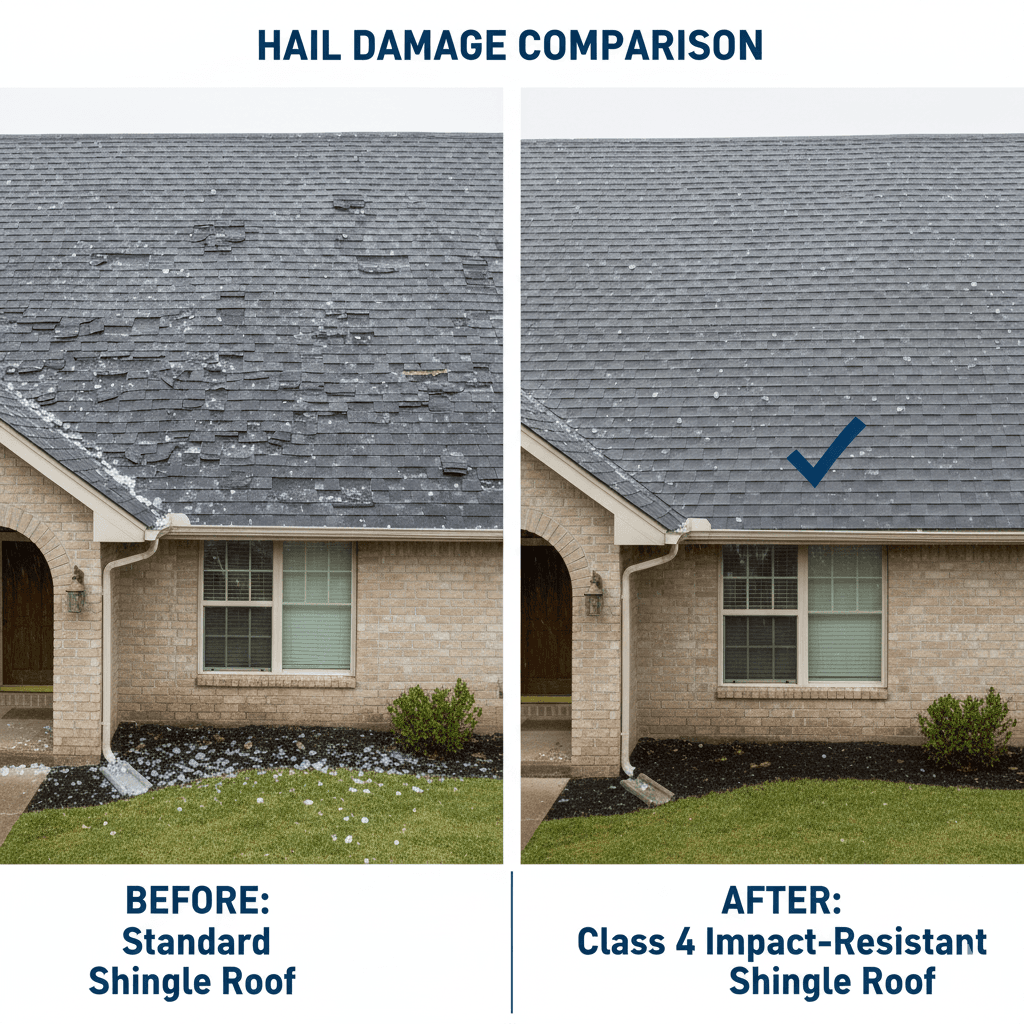
Hail impacts compress the granule layer into the fiberglass mat, loosening granule adhesion and exposing the underlying asphalt to UV radiation. The damage isn't always immediately visible from below — impact sites are often dime-to-quarter-sized circular areas where granules are depressed or missing.
Over time, these impact sites:
- Accelerate UV degradation of the asphalt
- Create micro-cracking in the fiberglass mat
- Become entry points for moisture infiltration
- Reduce the shingle's rated lifespan by 5–10+ years depending on severity
Large Hail (1.5"+)
Golf-ball-sized and larger hail (which Taylor has seen in documented events) can:
- Crack ridge caps outright
- Punch through older 3-tab shingles
- Dent and deform metal flashing at penetrations
- Crack pipe boots if they've become brittle from age and heat
What's Covered vs. What's Not
Standard homeowners policies cover sudden storm damage. They typically don't cover:
- Normal wear and aging
- Cosmetic damage only (if your policy has a cosmetic exclusion rider — check your declarations page)
- Pre-existing damage from prior events
If you have an older roof (15+ years) and there are multiple storm events in the history, your claim may be complicated by questions of "which event caused this?" — which is another reason a contractor with thorough documentation is valuable.
Taylor, Texas-Specific Considerations
The Mixed Housing Stock
Taylor's housing stock ranges from pre-war homes in Historic Downtown Taylor to brand-new construction in Taylor Ranch, Mustang Creek, and Donahoe Creek Estates on the city's edges. Older homes may have:
- Multiple layers of shingles — in Texas, two layers maximum are allowed. A third re-roof requires full tear-off, adding cost.
- Board sheathing decking — requires different installation approach and may have rot that needs repair before new shingles go on.
- Older or undersized gutters — if hail damaged your shingles, it almost certainly dented your gutters too. Factor gutter replacement into your claim.
Construction Demand in Taylor
Samsung's campus has driven significant construction activity in Taylor and surrounding areas. That means two things for roofing:
- Contractor availability can be tighter than in other Williamson County markets — especially after a storm event. The best contractors fill up fast; don't delay your inspection.
- Material lead times can be longer — factor this into your timeline if you're scheduling a full replacement.
Screening a Roofing Contractor in Taylor TX
After any major storm, Taylor, Texas will see "storm chasers" — out-of-town roofing contractors who appear after significant weather events, offer to "work with your insurance," and may disappear when warranty issues arise later. When choosing a local roofer in Taylor TX, screen carefully:
- Require a Certificate of Insurance and verify it directly with the carrier (Texas has no state roofing license to check instead)
- Require a physical Texas business address — not a PO box
- Get a written contract before any insurance paperwork is signed
- Check Google and BBB reviews for recent work in Taylor and Williamson County specifically
Frequently Asked Questions
How long does a hail damage claim take in Texas? Most straightforward claims resolve in 4–8 weeks from the date of filing. Complex claims with disputes can take 3–6 months if appraisal is invoked.
Can I do repairs before the adjuster comes? Emergency repairs to prevent further damage (tarping an active leak, for example) are generally covered and advisable. Do not do permanent repairs before the adjuster inspection — this limits the carrier's ability to assess and may reduce your payout.
What if my claim is denied? You can dispute a denial. Request a written denial letter with the specific policy language the carrier is relying on. Have a second contractor review the denial rationale. If you believe the denial is improper, you can file a complaint with the Texas Department of Insurance or invoke your policy's appraisal process.
Does filing a claim raise my rates? Possibly — a storm claim is generally a "no-fault" event but carriers do factor claim history into renewal pricing. If the damage is minor, it may be worth comparing the repair cost to your deductible before filing. For significant damage, the claim is almost always worth it.
Free Hail Damage Roof Inspection in Taylor TX
Ripple Roofing is a local roofing company serving Taylor, Texas and all of Williamson County. As a CertainTeed ShingleMaster Premier-certified roofing contractor, we offer free, no-pressure roof inspections with written photo reports — the kind of documentation that makes the difference in an insurance claim.
Whether you're in Downtown Taylor, Taylor Ranch, Mustang Creek, Heritage Oaks, or anywhere else in the Taylor, TX area, we can typically schedule within 1–2 business days.
Schedule your free roof inspection in Taylor TX or call (512) 763-5277. We're based in Round Rock, 15 minutes from Taylor, with 24/7 availability for active leaks and storm emergencies.