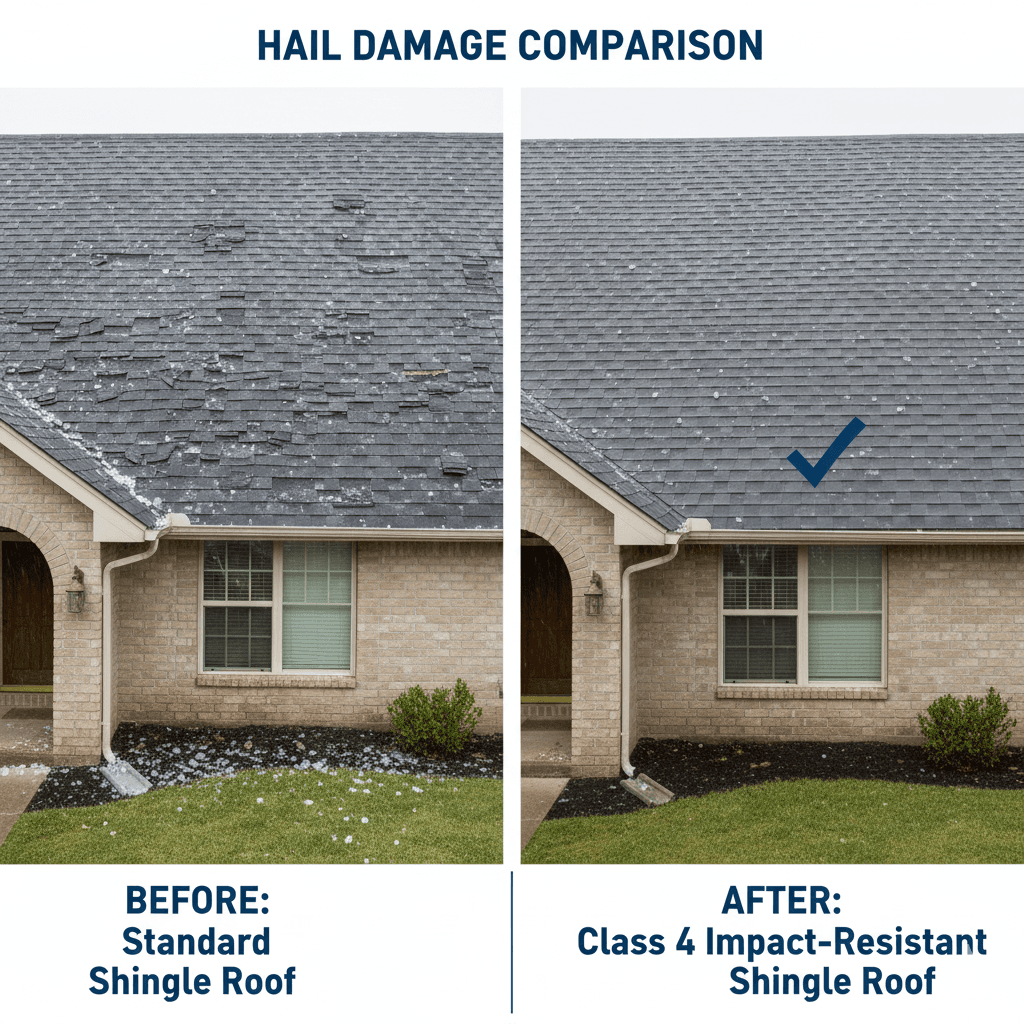
Central Texas just got hit again. A significant hail storm swept through Waco, Hewitt, Woodway, Bellmead, and surrounding McLennan County communities in spring 2026, leaving a trail of roof damage across some of the area's most established neighborhoods.
If you live in Waco's Woodway Estates, Hewitt Ranch, the Baylor University area, Sanger Heights, Cameron Park, or any neighborhood across McLennan County — your roof was almost certainly in the storm's path.
Need a free roof inspection right now? Call us at (512) 763-5277 — we serve McLennan County and can be out to assess your roof quickly.
McLennan County: One of Texas's Most Hail-Active Counties
This isn't surprising to longtime Waco residents. McLennan County sits squarely in the path of Central Texas's most active severe weather corridor — storms that develop over the Texas Hill Country and Edwards Plateau track northeast directly over Waco before continuing toward Dallas.
According to NOAA data, the greater Waco area averages 4–7 significant hail events per year, with events exceeding 1 inch occurring multiple times in active seasons. The spring 2026 storm season has been particularly aggressive across Central Texas.
If you're reading this shortly after the storm, document your damage today. Texas insurance policies have timely reporting requirements, and the official NWS storm record creates your evidentiary timestamp.
Which Waco-Area Neighborhoods Are Most at Risk?
Based on typical storm tracks through McLennan County, the areas with highest hail exposure include:
City of Waco:
- Woodway Estates and surrounding western Waco corridors
- West Waco and Sanger Heights
- Cameron Park (riverfront historic district)
- Mountainview and Castle Heights
- North Waco near TSTC and the airport corridor
City of Hewitt:
- Hewitt Ranch and Estates of Hewitt
- The Preserve at Hewitt
- Kendrick Farms
- Southern Hills and Windmill Farms neighborhoods
City of Woodway:
- Stone Ridge and Hunter's Chase
- Woodway Hills and Country Club Estates
- Alta Vista and Lakeview Estates
- Bosque Boulevard corridor
Bellmead / Lacy-Lakeview:
- North Bellmead residential areas
- TSTC-adjacent neighborhoods
- Loop 340 corridor
Surrounding Communities:
- McGregor (western McLennan County)
- Lorena and Bruceville-Eddy (southern McLennan County)
- Hillsboro and Hill County communities to the north
- Corsicana and Navarro County to the northeast
If you're in any of these areas, assume your roof needs a professional inspection even if you don't see obvious exterior damage. The most costly hail damage is often invisible from the ground.
What Does Central Texas Hail Do to Your Roof?
Granule Loss: The Silent Killer
Asphalt shingles are coated with mineral granules that serve three critical functions:
- UV protection — shields the asphalt base from Texas sun degradation
- Fire resistance — forms a barrier against ember spread
- Water shedding — helps channel rain off the surface
When hail strikes a shingle at 50–70 mph terminal velocity, it blasts granules off in a circular impact pattern. From the ground, your roof may look fine. But in your gutters, you'll find dark, sandy material — that's your roof's protective layer washing away.
Check your gutters today. Significant granule accumulation after a hail event is one of the strongest forms of claim evidence.
Bruising and Mat Fractures
Beneath the granules is an asphalt-fiberglass mat. Direct hail impact — even from 3/4" stones — can fracture that mat without breaking through to the surface. This "functional loss" means the shingle is no longer performing as designed, even if it looks intact from 20 feet below.
Insurance adjusters use a chalk grid test and physical pressure to identify mat fractures. An experienced roofing contractor will document the same way.
Seal Strip Damage
Modern architectural shingles have a self-sealing adhesive strip that bonds layers together and prevents wind uplift. Repeated hail impacts can break that bond, leaving your shingles vulnerable to blow-off in the next storm.
Metal Component Dents
Hail leaves unmistakable evidence on soft metal surfaces: AC condenser fins, gutter edges, ridge cap flashing, pipe boots, and chimney caps. These dents are often more visible than shingle damage and serve as critical supporting evidence for your insurance claim.
How to Document Your Hail Damage Today
The clock is running. Here's the documentation sequence that maximizes your claim:
Step 1: Check Your Gutters and Downspouts
Go outside right now and inspect:
- Granule accumulation in gutters — photograph any significant buildup
- Dented gutter edges — fresh dents with no oxidation mean recent impact
- Downspout dents — same verification on vertical surfaces
Gutter dents are among the strongest insurance claim evidence because they are verifiable, dateable, and impossible to fabricate.
Step 2: Inspect Soft Metal Surfaces
Before getting on the roof:
- AC condenser fins — new dents without oxidation indicate this storm
- Garage door panels — fresh dings
- Window screens and frames — hail tears screen mesh and dents aluminum frames
- Mailbox top — surprisingly useful hail evidence
- Painted fence caps and deck rails
Photograph everything with timestamps. These items confirm hail size and intensity independently of the roof.
Step 3: Do a Ground-Level Roof Survey
Do not get on the roof yourself. Walk all four sides and look for:
- Missing shingles or obvious surface damage
- Dark circular impact marks or missing granule zones (use binoculars or phone zoom)
- Ridge cap damage — peaks take direct hits and are often the most visible
- Chimney flashing dents
Step 4: Record a Video Walkthrough
Use your phone to record a continuous video of your entire property, narrating what you see. Video timestamps are automatic. Combined with the official NWS storm record, this creates a clear timeline for your adjuster.
Step 5: Document Neighbor Damage
If neighboring homes show visible damage, photograph from the street. Widespread damage across multiple homes in a cluster strengthens every individual claim.
Filing Your Insurance Claim: Texas Steps
1. Call Your Insurer Within 48–72 Hours
Open your claim promptly. Key language:
- "I experienced hail damage from the spring 2026 storm that affected McLennan County, TX."
- Request an adjuster inspection
- Get your claim number immediately
2. Get a Contractor Inspection BEFORE the Adjuster
This is the step most homeowners skip — and it costs them thousands. A licensed roofing contractor who inspects before the adjuster creates an independent damage report. If the adjuster misses items (it happens frequently after large-scale hail events), your contractor can supplement the claim with documentation you already have in hand.
Schedule your free post-storm inspection → or call (512) 763-5277. We inspect throughout McLennan County and surrounding areas.
3. Know Your Policy Type: ACV vs. RCV
- ACV (Actual Cash Value): Pays depreciated roof value. A 15-year-old roof on an ACV policy may receive minimal payment.
- RCV (Replacement Cost Value): Pays to replace your roof with like kind and quality. This is what you want.
Check your declarations page before the adjuster arrives. If you're on ACV and your roof is older than 10 years, ask your agent about upgrade options now.
4. Beware of Storm Chasers
After a major hail event in Waco, out-of-town contractors flood neighborhoods. Many ask you to sign an Assignment of Benefits (AOB) or "direction to pay" form — these transfer your insurance rights to the contractor, removing your ability to negotiate or dispute the claim.
Work only with licensed Texas contractors who provide written estimates and let you control your claim. Ripple Roofing is based in Central Texas — we're not storm chasers, and we'll be here after the job is done.
Why the Waco Area Gets Hit So Hard
Waco's geographic location is, frankly, unlucky when it comes to severe weather. The city sits at the convergence of three key factors:
1. Storm Track Alignment Severe thunderstorms that develop over the Concho Valley and Edwards Plateau track northeast along a corridor that passes almost directly over Waco before continuing toward Dallas/Fort Worth. This gives McLennan County some of the state's highest frequency of large hail.
2. Flat Terrain Unlike Hill Country areas with natural topographic barriers, the Brazos River plains around Waco offer no terrain-based protection from approaching storms. Winds and hail carry full force across the metro area.
3. The Dry Line Texas's infamous dry line — the boundary between moist Gulf air and dry continental air — frequently sets up near the I-35 corridor. Where the dry line stalls or oscillates, supercell thunderstorms with large hail are most likely.
This isn't speculation — it's documented in NOAA's historical hail data. McLennan County property owners should treat impact-resistant roofing as an investment necessity, not a luxury.
Impact-Resistant Roofing: Your Best Defense for Next Time
If your roof takes significant hail damage and needs replacement, this is the moment to upgrade to Class 4 impact-resistant shingles. In Texas, this upgrade typically pays for itself through:
Insurance Premium Discounts Most Texas homeowner insurers offer 10–30% premium discounts for Class 4 (UL 2218) impact-resistant shingles. On a $3,000/year policy, that's $300–$900 per year — potentially covering the upgrade cost within a few years.
Longer Replacement Cycles Standard architectural shingles in McLennan County's hail environment may need replacement every 12–18 years. Class 4 shingles are engineered to withstand 1.5–2" steel ball impacts at 90 mph — dramatically extending the replacement cycle.
Peace of Mind Through Storm Season When the next hail event sweeps through Waco (and it will), you'll watch the storm pass rather than waiting to see if your claim is approved.
We install CertainTeed's NorthGate Class 4 IR shingles and GAF's Armor Shield II — both proven performers in Central Texas conditions. Ask about impact-resistant options when you schedule your inspection.
Ripple Roofing: Serving McLennan County and All of Central Texas
We serve Waco, Hewitt, Woodway, Bellmead, McGregor, Temple, Killeen, and communities across Central Texas. Our team understands McLennan County's weather, the insurance carriers active in this area, and exactly how to document hail damage in a way that holds up through the claims process.
- Free post-storm inspections — no obligation, no pressure
- Insurance claim assistance — we work directly with your adjuster
- CertainTeed ShingleMaster Premier certified — the highest installer certification available
- Licensed & insured in Texas — RRC # verified
- Impact-resistant roofing specialists — Class 4 shingles with insurance discount documentation
Schedule Your Free Inspection →
Or call us directly: (512) 763-5277
We'll be in the Waco area assessing homes. Get on the schedule now before the backlog builds.
Frequently Asked Questions: Waco Hail Damage
Q: My roof looks fine from the street. Do I still need an inspection? A: Yes. The most expensive hail damage — bruised mats, granule loss, broken seal strips — is invisible from street level. A professional inspection with a chalk grid test takes 45 minutes and is free. The cost of a missed claim can be $15,000–$30,000.
Q: How long do I have to file a claim? A: Texas law requires reporting "as soon as practicable." Your policy may also have a specific time limit (often 1–2 years). However, insurers use weather records to verify storm dates — the official NWS record supports your claim as long as you act reasonably promptly. Don't wait months.
Q: The insurance adjuster said I have no damage. What do I do? A: Request a re-inspection with your contractor present, or have your contractor create a formal supplemental estimate. You have the right to dispute an adjuster's findings. A public adjuster or your contractor can advocate for you.
Q: Can I just patch the damaged areas? A: Partial repairs are possible for minor localized damage. However, if hail has caused widespread granule loss across the roof surface, a full replacement is typically required — and what your insurer should cover under an RCV policy.
Q: Should I get impact-resistant shingles if I'm replacing my roof? A: In McLennan County, the answer is almost always yes. The insurance discount ROI is compelling, and the protection through future hail events is significant. Ask us for a side-by-side comparison during your inspection.
Central Texas storm tracking data referenced from NOAA's Storm Prediction Center and National Weather Service Fort Worth (WFO FWD) and Austin/San Antonio (WFO EWX) forecast offices. All storm reports are preliminary and subject to update.