Why Is My Roof Leaking? A Room-by-Room Guide to Finding the Source in Taylor, TX
A roof leak rarely announces itself as a hole. It shows up as a stain — a yellow-brown ring on a ceiling, a damp patch on drywall, a musty smell in a closet you can't quite place. What trips up most Taylor homeowners is that the location of that stain feels random. It isn't. Water follows a predictable path once it gets past your shingles, and where it finally shows up inside your home is a real clue to where it's getting in.
This guide is organized differently from most roof repair content. Instead of starting with roof components — pipe boots, flashing, valleys — it starts with what you're actually looking at right now: a stain on a ceiling or wall, and a question about where it's coming from. Find the symptom below that matches what you're seeing, then use our roof repair guide for Taylor TX for what the fix typically costs once you have a working theory of what's wrong.
One caveat before we start: this guide will help you narrow down the likely cause and decide how urgently to act. It is not a substitute for someone getting on the roof and confirming it. Water travels — sometimes several feet from where it enters to where it finally drips through — so treat every diagnosis below as a strong hypothesis, not a certainty, until a professional confirms it from above.
Why Where It Shows Up Matters
Water doesn't fall straight down once it gets under your shingles. It runs along the top of the underlayment and the underside of the roof decking, following the slope of the roof, until it hits an obstruction — a rafter, a truss member, a clump of insulation, a wiring run — and only then drips downward into the living space below. That means the stain on your ceiling can be offset, sometimes by several feet, from the actual point of entry above it.
This matters more in Taylor than in a lot of Central Texas cities because of how varied the housing stock is here. Homes built before the 1970s near the historic downtown core typically have 1×6 or 1×8 board sheathing instead of continuous plywood or OSB panels — water can travel along the gaps between boards in ways that don't match how it moves across a solid modern deck. If your home is in this age range and the stain location doesn't seem to line up with any obvious roof feature above it, that's often why.
Map Your Leak: What the Location Usually Means
1. A Circular or Oval Stain in the Middle of a Room, Often Below a Bathroom, Laundry Room, or Kitchen
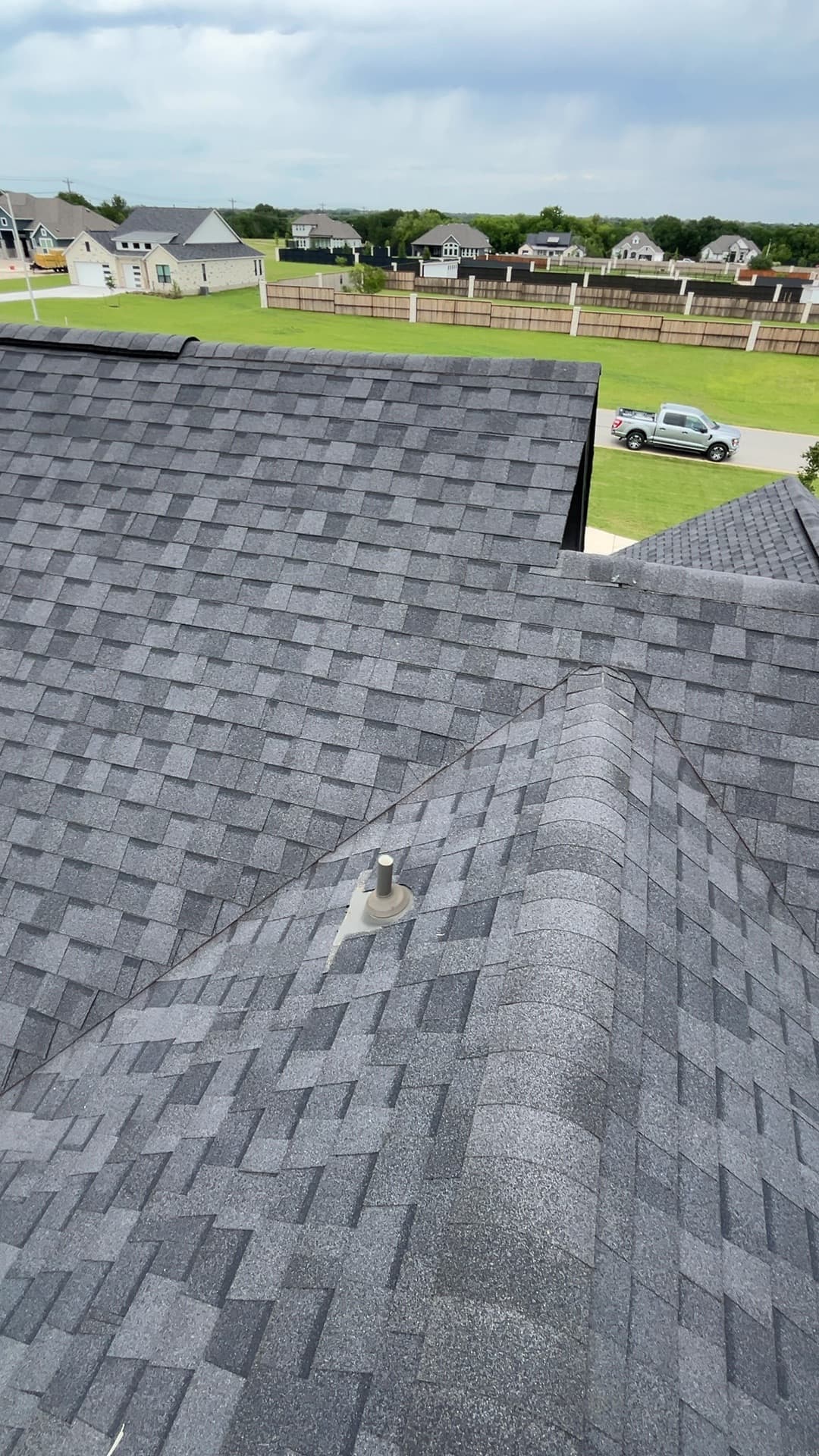
Likely cause: A failed pipe boot. Every plumbing vent stack that runs from your bathrooms and kitchen up through the roof is sealed at the roofline with a rubber or lead collar. In Texas heat, standard rubber boots have a service life of roughly 10–15 years before they crack and pull away from the pipe.
What confirms it: The stain sits roughly below where you'd expect a vent stack to run — almost always tied to a bathroom, laundry room, or kitchen plumbing wall. It tends to worsen gradually across multiple rain events rather than appearing all at once, and it's often a slow drip rather than a steady stream.
What it costs to fix: Our roof repair guide has current Taylor pricing — pipe boot replacement is the single most common repair call we get in this market, largely because so much of Taylor's housing stock is right at or past the 10–15 year window.
2. Staining Along the Ceiling-Wall Joint, Especially Near a Chimney or a Second-Story Exterior Wall
Likely cause: Step flashing or counter flashing failure. Anywhere your roof meets a vertical surface, a flashing system is doing the work of keeping water out — and it's one of the more failure-prone systems on any roof because it relies on sealant and metal-to-masonry (or metal-to-siding) contact staying intact over time.
What confirms it: The staining tracks the wall-to-ceiling transition specifically, rather than spreading across the open ceiling field. It's frequently worse on one side of a chimney than the others — the sun-exposed side degrades sealant faster — and often gets noticeably worse during wind-driven rain coming from a particular direction.
Taylor-specific note: Homes with original lead chimney flashing (common on pre-1980 construction here) are prone to fatigue cracking after decades of thermal expansion and contraction, even without an obvious storm event to blame.
3. A Stain That Traces a Diagonal Line, Typically Where Two Roof Slopes Meet Overhead
Likely cause: Valley flashing failure. A valley is where two roof planes drain into each other in a "V," and it carries more concentrated water volume than almost any other part of the roof. When valley flashing degrades — corroded metal, opened seams, worn shingle weave at the centerline — that concentrated flow finds its way in.
What confirms it: This type of leak shows up strongly during heavy rain specifically, because that's when valley flow volume peaks. It often appears near the bottom of the valley, close to the eave line, since that's where the water volume — and the flashing's workload — is greatest.
4. A Stain Along an Outer Wall That Only Shows Up When Wind Is Driving Rain Sideways
Likely cause: This is the one case on this list where the roof field itself often isn't the problem. Wind-driven rain along an outer wall is frequently caused by fascia rot letting water behind the gutter line, a gutter that's overflowing and splashing back under the drip edge, or even a window or siding intrusion point above the stain — not a shingle or underlayment failure at all.
What to check first: Look at your gutters after the next rain. If they're overflowing or pulling away from the fascia, that's a strong sign the moisture is coming from drainage, not the roof deck. Our gutter installation guide covers what healthy gutter attachment and flow should look like.
Why this matters: We'd rather tell you upfront that a wind-driven wall stain is frequently a gutter or fascia problem than have you pay for roof work that doesn't fix it. A proper inspection checks both systems together, because they're connected.
5. Staining Around a Skylight, a Roof-Mounted Vent or Fan, or a Solar Panel Mount
Likely cause: A failed penetration seal specific to that fixture. Every roof-mounted fixture — not just plumbing vents — has its own flashing kit, and each one is a potential entry point. Skylight flashing kits and solar mounting brackets are common sources of a leak that looks confusing because it doesn't correspond to any of the "usual" locations described above.
What confirms it: The stain is directly below, or very close to, the fixture in question, and the timing usually correlates cleanly with rain rather than showing up gradually.
6. A Musty Smell or Faint Discoloration in the Attic, With No Ceiling Stain Yet
Likely cause: This one is genuinely worth pausing on, because it isn't always a "leak" in the traditional sense. Two different problems present almost identically at this early stage:
- Condensation from inadequate attic ventilation — moist indoor air meeting a hot roof deck (or vice versa in rare winter conditions) can create surface moisture that looks like a slow leak but is actually a ventilation problem. This shows up regardless of whether it's raining.
- A genuine slow leak that hasn't saturated enough insulation yet to show through the ceiling drywall. This one correlates with rain, even if the correlation isn't obvious yet.
How to tell the difference: Ventilation-driven condensation tends to appear broadly across the attic and doesn't track with specific rain events. A slow leak tends to be localized to one area and gets worse after rain. Either way, this is worth an inspection before it becomes a ceiling stain — catching a ventilation problem here is far cheaper than catching it after it's accelerated shingle aging from below, which is a real and common issue in Taylor's summer heat.
7. A Stain That Appears Nowhere Near Any Obvious Roof Feature
Likely cause: Water traveling a longer path than usual before dripping down — along a truss, across a board seam, or through a compromised section of decking or underlayment well away from any penetration.
Taylor-specific note: This is more common in the city's pre-1970 board-sheathed homes than in modern OSB construction, because water can travel along board-to-board seams in directions that don't match the roof's slope. If your home is in this category and the stain location seems to defy explanation, that's often exactly why — and it's a good reason to have a board-sheathing-experienced crew do the inspection rather than one that works exclusively on modern decking.
8. A Stain That Appeared Once, During One Specific Storm, and Hasn't Come Back
This is a distinct and genuinely tricky case. Two explanations are both common:
- A shingle tab that lifted temporarily under high wind and resealed itself as Texas heat softened the asphalt back into place. This happens more than people expect, and it can mean the roof is basically fine.
- A marginal seal that only fails under a specific combination of wind direction and intensity — meaning it will very likely happen again the next time that specific condition recurs, which could be months away.
What to do: Don't take "it stopped" as "it's fixed." Both explanations look identical from inside the house. An inspection can usually tell them apart by examining the shingle and flashing condition directly, which is the only way to know whether you got lucky once or fixed nothing.
What You Can Safely Check Yourself
- A flashlight attic check, if your attic is safely accessible: look for staining on the underside of the decking, insulation that looks compressed or darkened in one area, and rusty or damp nail tips poking through the decking — an early, low-drama indicator of moisture that's worth flagging even before any ceiling staining appears.
- A ground-level walk-around with binoculars: missing or lifted shingles, a sagging gutter section, daylight gaps at flashing lines, and any visibly displaced ridge cap.
- Timing notes: does the stain appear only during rain, only during wind-driven rain from a specific direction, or does it show up even on dry days? That last pattern points toward condensation or a plumbing issue rather than the roof.
What Not to Do
- Don't paint or caulk over the stain itself. It hides the symptom without addressing the source, and it makes it harder for an inspector to gauge how long the moisture has been present.
- Don't wait to "see if it dries out." Repeated wetting and drying of drywall and insulation is how a $300 repair turns into a mold remediation and drywall replacement project.
- Don't assume a small stain means a small problem. A dime-sized stain can represent months of slow saturation happening above a ceiling that just hasn't given way yet.
- Don't get on the roof yourself, especially after or during rain. Wet shingles are slick even on a shallow pitch, and a hail- or wind-damaged roof surface can be less stable underfoot than it looks.
When to Call Today vs. This Week
Call today (or use our emergency roof repair guide) if you have active dripping, a visibly sagging or bulging ceiling, water tracking near an electrical fixture, or a stain that's rapidly spreading.
Schedule within the week if the stain is stable, dry to the touch, and not actively growing. It still needs attention — untreated moisture behind drywall doesn't resolve itself — but it's not an emergency-response situation.
Frequently Asked Questions
How much damage can happen before I even notice a leak?
More than most homeowners expect. Water can saturate attic insulation and travel along framing members for weeks before enough volume accumulates to show through ceiling drywall. By the time you see a stain, the leak has usually been active for a while — which is exactly why an inspection typically finds more than just "the one spot."
Can a leak really be intermittent, or does that mean it's not serious?
It can be genuinely intermittent, and intermittent doesn't mean minor. A marginal flashing seal or a borderline pipe boot can leak only under specific wind and rain combinations, sitting dry for months in between. The underlying component is still failing; it's just not failing every time it rains.
Will homeowners insurance cover the interior damage from a leak?
It depends on the cause. Damage from a covered peril — hail, wind, a fallen limb — that leads to a leak is typically covered, subject to your deductible. Damage from gradual wear, deferred maintenance, or a component that simply reached the end of its service life generally is not. Our Taylor TX hail damage guide walks through the claims process for storm-caused damage specifically.
Is it possible this is just condensation and not a real leak?
Yes, and it's worth ruling out before you assume the worst. Condensation from inadequate attic ventilation can mimic early leak symptoms — musty smell, faint ceiling discoloration — without any actual roof penetration failure. A professional inspection distinguishes between the two by checking whether the moisture pattern correlates with rain events or with attic temperature and humidity conditions.
How fast should I act once I notice a stain?
Faster than most people do. A stain that isn't actively dripping doesn't feel urgent, but the moisture behind it doesn't pause while you wait. Getting an inspection scheduled within a week of noticing a stable, non-emergency stain is a reasonable target — and it's free to find out.
Schedule a Free Leak Diagnosis in Taylor TX
Ripple Roofing is a CertainTeed ShingleMaster Premier-certified roofing contractor serving Taylor, Texas and all of Williamson County. We diagnose leaks with a full roof and attic inspection — not a guess based on where the stain happens to be — and give you a written photo report showing exactly what we found and why.
We serve all Taylor neighborhoods: Downtown Taylor, Taylor Ranch, Mustang Creek, Heritage Oaks, Donahoe Creek Estates, North Taylor, East Taylor, and the Murphy Street District. We're based in Round Rock, 15 minutes from Taylor, with 24/7 availability for active leaks.
Schedule your free leak inspection in Taylor TX or call (512) 763-5277 to speak directly with our team.