Metal roofing has moved from a niche upgrade to one of the most requested roofing options in Taylor, TX — and for good reason. Between the hailstorms that roll through Williamson County every spring, summers that push attic temperatures past 160°F, and the surge in home values that's followed Samsung's $17 billion semiconductor plant announcement, homeowners here are making longer-term investments than ever before. A metal roof is one of the clearest examples of that shift.
But "metal roofing" isn't a single product — it's a category that includes four meaningfully different systems, each with different price points, aesthetics, performance profiles, and ideal use cases. What's right for a historic 1940s cottage near downtown Taylor is not the same as what's right for a 2,400 square foot Samsung-era new build in Taylor Ranch. This guide walks through all of it: the types, the real costs, how metal performs against Central Texas's specific challenges, and how to match the right system to your home.
If you've been told "just get a metal roof" without more specifics, this is the guide that gives you those specifics.
The 4 Types of Metal Roofing Available in Taylor TX
Not every metal roof looks or installs the same way. Here are the four systems you'll encounter from contractors serving Taylor and Williamson County.
1. Standing Seam Metal Roofing
Standing seam is the premium tier of residential metal roofing and the system most people picture when they think of a modern metal roof. Panels run vertically from ridge to eave, and the fasteners are completely concealed within raised interlocking seams — meaning no exposed screws, no penetrations that can leak, and no UV degradation of fastener gaskets over time.
Two variants exist:
Snap-lock standing seam panels interlock without additional fastening hardware. They're faster to install and adequate for most residential pitches. The trade-off is slightly less wind uplift resistance compared to mechanically seamed panels.
Mechanically seamed standing seam uses a specialized seaming tool that rolls the panel seams together after installation, creating an extremely tight, watertight joint. This is the standard for commercial applications and steep-pitch residential roofs in high-wind zones. For Taylor homes in exposed locations or with complex roof geometries, mechanical seam is worth the modest price premium.
Panel widths typically run 12–18 inches. Narrower panels give more shadow lines and a more architectural look; wider panels go on faster and cost slightly less in labor.
Best for: Modern, contemporary, or craftsman homes. Historic Taylor downtown properties with Craftsman or Prairie-style architecture. Any homeowner prioritizing the cleanest possible long-term performance.
Typical gauge: 24-gauge steel with Kynar 500 paint finish, or 22-gauge for higher-end installs.
2. Stone-Coated Steel Roofing
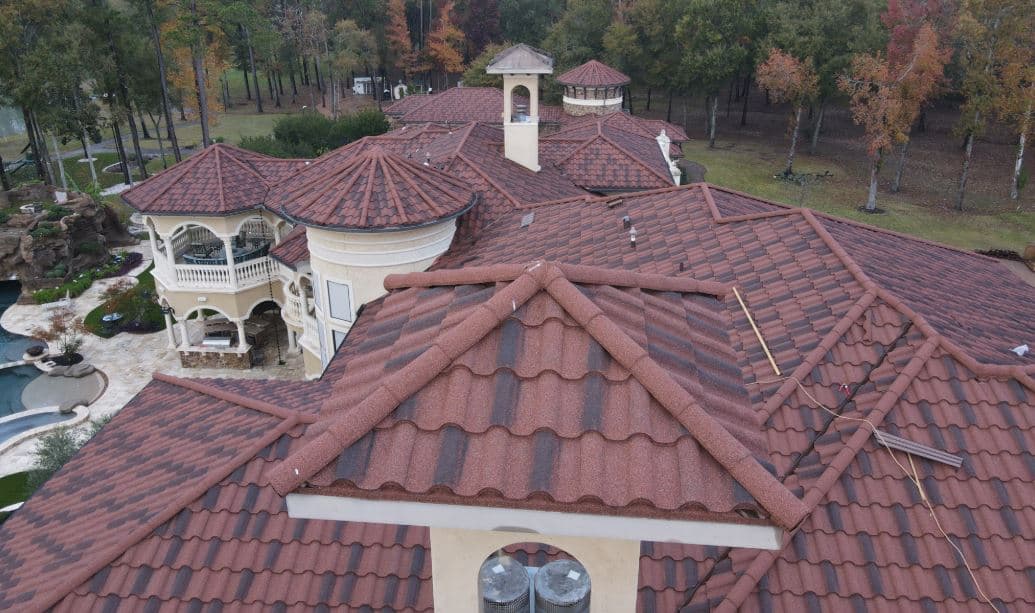
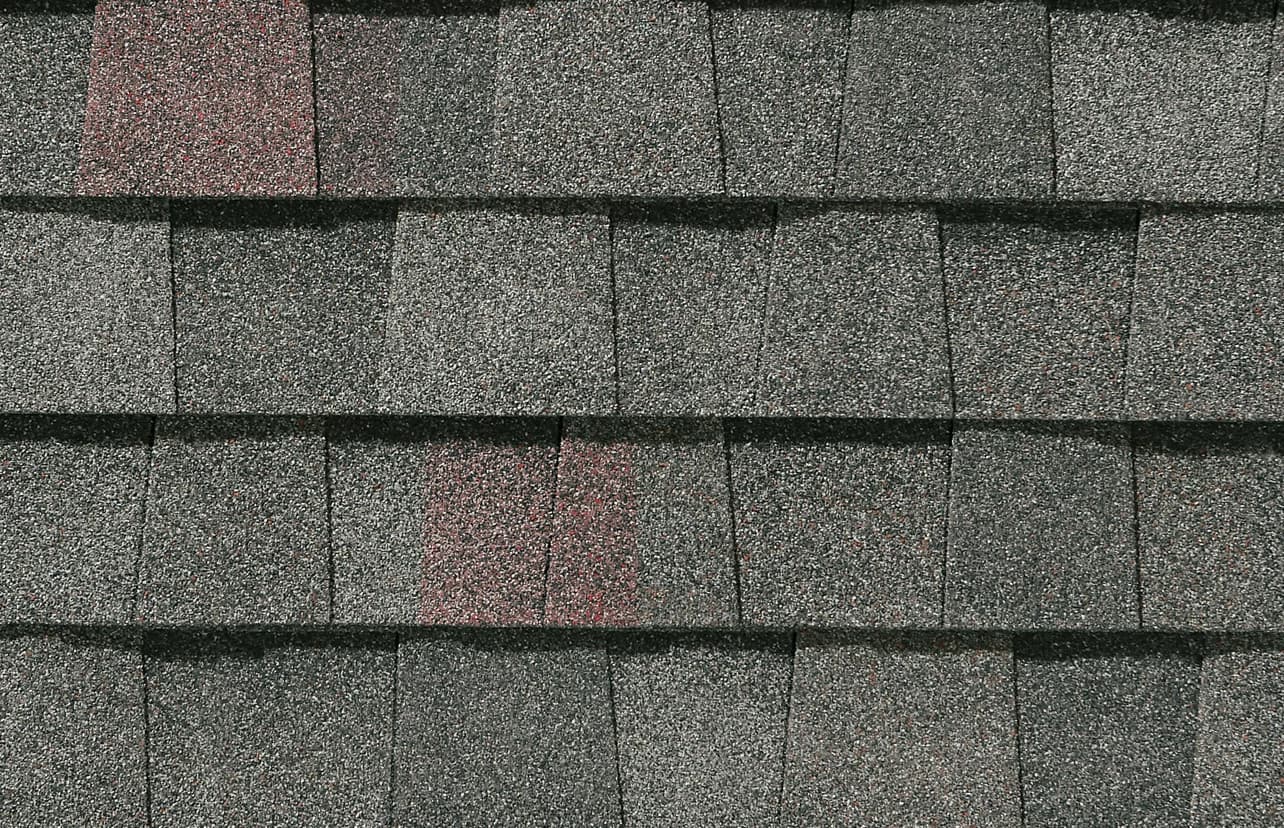
Stone-coated steel gives you the performance of steel with the visual profile of traditional roofing materials. Steel panels are press-formed into shingle, tile, or shake profiles, then coated with acrylic-bonded stone granules — the same type of granules used on asphalt shingles, but applied over steel rather than a fiberglass mat.
The result: a roof that looks remarkably similar to high-end asphalt shingles or barrel tile from the street, but with a 50-year lifespan, Class 4 impact resistance, and the full weather performance envelope of steel.
Popular stone-coated steel products include Decra, EDCO, and Boral (now Westlake Royal). Each has slightly different profiles and color ranges, but all share the core performance characteristics.
Class 4 impact resistance is the key differentiator. Class 4 is the highest UL 2218 rating — the product has passed testing against 2-inch diameter steel ball bearings dropped from 20 feet. For Taylor homeowners navigating Williamson County's documented hail history, Class 4 certification is often the difference between a $0 insurance deductible scenario and a complete replacement out-of-pocket.
Best for: Mid-century homes (1970–2000) where changing the visual roofline would look out of place. Neighborhoods with HOA restrictions on roof appearance. Homeowners who want metal performance but prefer a traditional look.
3. Metal Shingles
Metal shingles split the difference between stone-coated steel and standard standing seam. They're individual panels (rather than long runs) stamped to look like asphalt shingles, wood shakes, or slate, and installed much like their traditional counterparts — in overlapping courses from eave to ridge.
Pros: Easier to repair a section if damaged; can sometimes qualify for Class 4 insurance discounts; lower installed cost than standing seam; familiar installation process for roofing crews.
Cons: The exposed fastener approach (in some systems) creates more potential leak points than concealed-fastener standing seam; less dramatic aesthetic than full standing seam panels; not ideal for low pitches.
Best for: Homeowners who want metal longevity but prefer the look of traditional shingles; budget-conscious buyers upgrading from asphalt.
4. Exposed Fastener / Corrugated Metal
Corrugated metal and R-panel systems use screws driven directly through the panel face into the substrate below. They're inexpensive, fast to install, and extremely durable for their cost.
However: We don't recommend exposed-fastener systems for primary residence roofing in Taylor. The screws are sealed with neoprene washers that degrade in Central Texas heat over 10–15 years, creating a systematic leak failure pattern. These systems are appropriate for barns, outbuildings, and agricultural structures — not for a home.
If a contractor is quoting corrugated or R-panel for your primary residence, ask specifically about the fastening system before accepting the bid.
Metal Roofing Cost in Taylor TX: 2026 Installed Price Ranges
Metal roofing costs vary significantly by system type, home size, and complexity. These are installed costs (materials + labor + tear-off of existing roof) for Taylor TX homes in 2026.
| System | 1,500 sf Home | 2,000 sf Home | 2,500 sf Home | 3,000 sf Home |
|---|---|---|---|---|
| Metal shingles | $14,000–$19,000 | $18,000–$25,000 | $22,000–$31,000 | $26,000–$37,000 |
| Stone-coated steel | $18,000–$26,000 | $24,000–$34,000 | $30,000–$43,000 | $36,000–$52,000 |
| Standing seam (snap-lock) | $22,000–$32,000 | $29,000–$42,000 | $36,000–$52,000 | $43,000–$62,000 |
| Standing seam (mechanical seam) | $26,000–$38,000 | $34,000–$50,000 | $43,000–$63,000 | $51,000–$75,000 |
Prices reflect the full project: tear-off, decking inspection/repair, underlayment, metal system, flashing, trim, and cleanup.
What Pushes Costs Higher in Taylor
Steep pitch: Roof pitches above 8:12 require additional safety equipment, slower installation, and sometimes crew surcharges. Many older Taylor homes — particularly the two-story Victorians near downtown — have steep pitches.
Multiple penetrations: Each pipe boot, skylight, chimney, or HVAC stack requires custom flashing fabricated to fit the metal panel system. A home with 8 penetrations costs more than a home with 2.
Board sheathing on older homes: Taylor has significant housing stock built before 1970 on solid board sheathing (1×6 or 1×8 boards spaced slightly apart) rather than plywood or OSB. Metal roofing requires a solid nailing surface — board sheathing often needs either new OSB overlaid on top or horizontal purlins installed to provide a proper substrate. Either approach adds $1,500–$4,000 to the job.
Multiple roof planes and valleys: A simple hip roof with 4 planes and no valleys is the easiest and least expensive. A complex home with dormers, hips, ridges, and multiple valleys in different directions takes significantly longer and uses more material.
Crane or lift access: Some Taylor homes — particularly those with difficult lot access, large mature trees, or long driveways — require a crane or material lift for panels. This adds $300–$800 to the project.
What Keeps Costs Lower
Simple geometry: A house with 2 or 4 roof planes and minimal penetrations is a faster, more material-efficient install.
Easy access: Clear driveway access and no overhead obstacles keep mobilization costs down.
Bundling with other work: If you're also replacing fascia, soffit, or gutters at the same time, you'll save one mobilization and the work flows together more efficiently.
Existing plywood/OSB decking in good condition: If the decking doesn't need replacement, that's a meaningful cost reduction.
Taylor TX Climate Challenges — How Metal Addresses Each
Metal roofing isn't just popular for aesthetic reasons. Taylor's specific climate creates four recurring challenges that metal handles better than asphalt shingles.
Hail
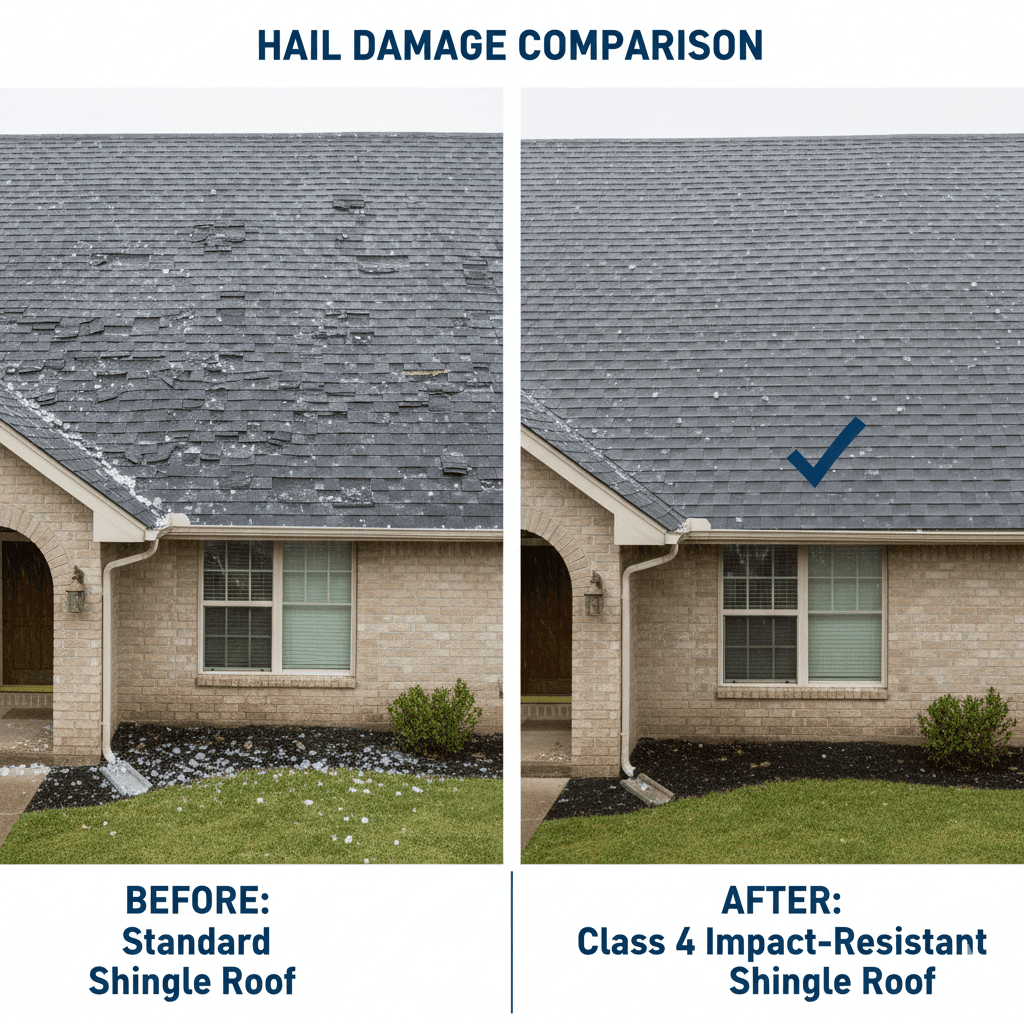
Williamson County sits in the middle of the Central Texas hail corridor. Most years see at least one significant hail event; some years see multiple events with stones 1 inch or larger. Asphalt shingles sustain impact damage that may not be immediately visible — granule loss accelerates aging even after moderate hail — and eventually necessitate full replacement.
Metal roofing responds to hail differently. Standing seam and stone-coated steel systems certified at Class 4 (the UL 2218 standard) have been tested to withstand 2-inch diameter hail impacts without functional damage. The practical result: most Class 4 metal roofs weather Williamson County hail events without replacement. In many cases, the insurance discount you receive for having a Class 4 roof pays for a significant portion of the upgrade cost over time.
Note: "cosmetic damage" clauses are increasingly common in Texas homeowner policies. Many policies specifically exclude insurance payouts for dents in metal roofs that don't affect function. Before selecting a metal product, verify with your carrier whether you have a cosmetic damage exclusion and whether a specific product is listed as covered.
Heat
Central Texas summers push roof surface temperatures to 150–180°F on dark asphalt shingles. Metal roofing with cool-roof-rated finishes (typically light colors with PVDF Kynar 500 or Hylar 5000 paint systems) reflects substantially more solar radiation — reducing surface temperatures by 30–50°F in many cases. The practical benefit for Taylor homeowners: lower attic temperatures, less work for your HVAC system, and measurably lower cooling costs during June–September.
The Texas HERO program and some utility rebates apply to cool-roof-rated metal systems. Ask your contractor for the product's SRI (Solar Reflectance Index) — a score above 78 qualifies for most cool roof programs.
Wind
Williamson County sees occasional straight-line wind events and tropical moisture remnants from the Gulf that can produce 60–80 mph gusts. Concealed-fastener metal systems (standing seam) are rated for 120–150 mph wind uplift depending on the panel design and installation method. Stone-coated steel systems typically carry 120+ mph ratings. These exceed what most homeowner policies require and significantly exceed the performance envelope of standard architectural shingles.
Rain and Moisture
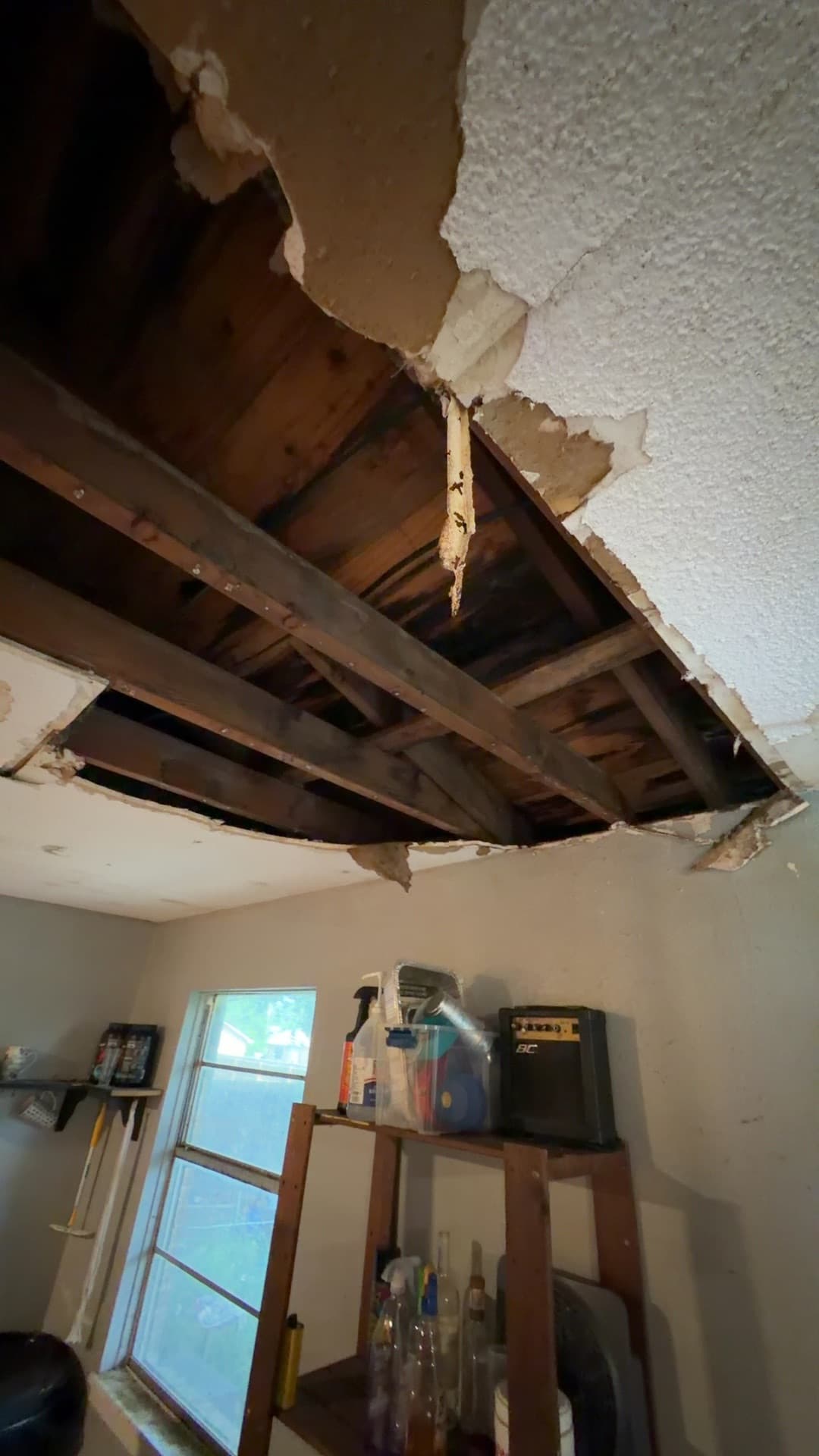
Asphalt shingles are essentially a water-management system built on a material that absorbs some moisture. Over time, that absorption — combined with UV degradation and thermal cycling — causes the mat to lose flexibility and eventually fail. Metal roofing is non-porous. It doesn't absorb water, doesn't grow algae without treatment, and doesn't develop the black streaking common on asphalt shingles in humid conditions. For Taylor homes near Taylor Creek or in low-lying areas where moisture and drainage are issues, this matters.
Matching Metal Roofing to Your Taylor TX Home Type
Taylor's housing stock spans roughly a century of construction — and each era has different considerations for metal roofing compatibility.
Historic/Pre-1970 Downtown Taylor Homes
The homes within and around Taylor's historic district — Victorian, Craftsman, Colonial Revival, and early mid-century styles — often have board sheathing, steep pitches, and more complex roof geometry. They're also the homes where neighbors and potential buyers will notice what the roof looks like most closely.
Best match: Standing seam metal. Historically, metal roofing (particularly standing seam) was used on premium homes in this era. A properly installed standing seam roof on a Craftsman bungalow is period-appropriate, not anachronistic. The clean vertical lines read as traditional rather than industrial.
Substrate consideration: Budget for OSB overlay or purlin installation over board sheathing. Most contractors who work in older Taylor neighborhoods have dealt with this routinely — get a specific line item for it in your bid.
Mid-Century Taylor Homes (1970–2000)
The ranch houses, split-levels, and starter homes built during Taylor's mid-century growth years are the largest segment of the housing stock. These homes typically have simple 4:12 or 5:12 pitches, plywood decking, and straightforward roof geometry.
Best match: Stone-coated steel. The visual profile of stone-coated steel shingles is nearly identical to architectural asphalt shingles from the street. You get the full performance benefits of metal — Class 4 hail, 50-year lifespan, insurance discount — without any visual disruption to the neighborhood. Most HOAs that don't specifically authorize metal allow stone-coated steel because it's indistinguishable from premium shingles.
New Construction / Samsung-Era Builds (2015–Present)
The newer subdivisions around Taylor — Taylor Ranch, Mustang Creek, and developments triggered by Samsung's arrival — are built on modern construction standards with OSB decking, standard pitches, and clean roof geometry. These are also the homes most likely to be held long-term, making the ROI on a premium roof most favorable.
Best match: Either standing seam or stone-coated steel. The choice here comes down to aesthetic preference and budget. Standing seam gives you a clean, modern look that pairs well with contemporary architecture. Stone-coated steel gives you slightly lower upfront cost with identical performance.
Metal vs. Architectural Shingles: Head-to-Head for Taylor Homeowners
This is the comparison most Taylor homeowners want to see before making a decision.
| Factor | Architectural Shingles | Stone-Coated Steel | Standing Seam |
|---|---|---|---|
| Installed cost (2,000 sf) | $12,000–$18,000 | $24,000–$34,000 | $29,000–$42,000 |
| Expected lifespan | 20–30 years | 40–50 years | 40–70 years |
| Hail resistance | Class 3 (with IR shingles) | Class 4 | Class 4 |
| Insurance discount potential | 5–15% (Class 4 shingles) | 10–30% | 10–30% |
| Maintenance | Inspect annually; replace sections | Minimal | Minimal |
| Resale value boost | Modest | Moderate | Significant |
| Installation timeline | 1–2 days | 2–4 days | 3–5 days |
| Wind rating | 130 mph (Class H) | 120–130 mph | 120–150 mph |
| Noise in rain | Minimal | Minimal | Slight increase (attic insulation dependent) |
| HOA compatibility | Always compatible | Usually compatible | Check with HOA |
The honest framing: architectural shingles are the right call when you're planning to sell within 5 years and can't recover the premium cost, or when the home's condition doesn't justify the investment in a 50-year roof. For most Taylor homeowners planning to stay and who value long-term protection in a hail-prone market, the math on metal is increasingly favorable.
Insurance Discounts for Metal Roofing in Taylor TX
The most underappreciated financial benefit of metal roofing in Texas is the insurance discount — and specifically, the Class 4 impact-resistant designation.
Texas law allows insurance carriers to offer premium discounts to homeowners who install Class 4 roofing products. The discount varies by carrier:
- State Farm: Typically 10–20% on the dwelling portion of the premium
- Allstate: 5–20% depending on location and claims history
- Farmers: 10–25% for Class 4 products
- USAA: Varies; confirm directly with your agent
- Texas Farm Bureau: Some of the largest discounts available — up to 30% in some markets
For a Taylor homeowner paying $3,000/year in home insurance, a 20% discount saves $600/year. Over 10 years, that's $6,000 in recovered premium — meaningful against the cost premium of metal over shingles.
How to access the discount:
- Get a copy of the product's UL 2218 Class 4 test report from your contractor
- Contact your insurance agent and tell them you're installing a Class 4 product
- Request a premium review effective on the installation completion date
- Provide the test report and your roofing permit if requested
Most adjustments take effect at your next renewal unless the carrier will mid-term adjust — call and ask.
What to Expect During Metal Roof Installation
Metal roof installation takes longer than shingle installation for the same home, but the timeline is predictable.
Day 1: Tear-off of existing roofing material, substrate inspection, deck repair if needed, installation of new underlayment (self-adhering membrane is standard for metal applications — it provides a watertight secondary barrier beneath the panels).
Day 2: Panel installation begins. For standing seam, panels are typically cut to length on-site using a portable rollformer and lifted into position by crew. Flashing around penetrations, valleys, rakes, and eaves is fabricated and installed as panels progress.
Day 3 (larger or complex homes): Remaining panels, ridge cap, trim work, penetration flashings completed.
Final day: Cleanup, gutters reattached if they were removed, inspection walkthrough with homeowner.
A Note on Installation Sounds
Two sounds sometimes surprise homeowners unfamiliar with metal:
During installation: Metal panels are louder to handle than shingles — you'll hear the crew working. This is normal and temporary.
After installation: Metal expands and contracts with temperature changes. On hot afternoons and cool evenings, you may hear occasional ticking or popping sounds from the roof — this is thermal movement, not structural distress. It's more noticeable in vaulted ceilings or homes with less attic space between the roof deck and living area. Proper underlayment and installation technique minimize this; a good contractor will discuss it with you in advance.
Metal Roofing Warranties: What You're Actually Getting
Metal roofing warranties have more layers than shingle warranties. Here's what each covers:
Paint/finish warranty: The coating manufacturer (PVDF Kynar 500 or Hylar 5000) typically warrants fade and chalk resistance for 30–40 years. This is a material warranty on the paint only.
Panel structural warranty: The panel manufacturer warranties the steel against perforation and structural failure. Standard panels carry 40-year warranties; premium products go to 50 years. This is a prorated warranty in most cases — coverage decreases over time.
Contractor workmanship warranty: This is the one most homeowners miss. The panel warranty covers the product; the workmanship warranty covers the installation. A manufacturer warranty won't cover a leak caused by improper flashing at your chimney. A good contractor workmanship warranty runs 5–10 years minimum on metal work. At Ripple Roofing, our CertainTeed ShingleMaster Premier certification gives us access to backed workmanship warranties on CertainTeed products — ask specifically about workmanship coverage for any metal product your contractor is proposing.
Questions to Ask Any Metal Roofing Contractor in Taylor TX
Metal roofing requires specific installation knowledge. Not every contractor who does shingles does metal well. These questions help you identify who has real experience.
1. What metal products do you install and are they Class 4 certified? Ask for the product name and manufacturer, and request a copy of the UL 2218 test report. Any legitimate metal roofing contractor has these on file.
2. Do you fabricate panels on-site or use pre-cut panels? Standing seam panels cut on-site with a portable rollformer are custom-fit to your roof. Pre-cut panels require more seams and are more prone to length mismatch on non-standard roofs.
3. How do you handle penetrations? Pipe boots on metal roofs require different products than those used on shingle roofs. Ask specifically what they use for pipe boot flashings — the answer tells you how detail-oriented they are.
4. What gauge steel are you installing? 24-gauge is the minimum acceptable for residential standing seam. 26-gauge is thinner and not recommended. If they can't tell you the gauge, that's a red flag.
5. What's the substrate preparation process for my home? If you have an older home with board sheathing, they should immediately identify that as something requiring attention. If they just say "we'll install over what's there," ask more questions.
6. What does your workmanship warranty cover and for how long? Get the workmanship warranty in writing as part of the contract.
7. Can you provide a Certificate of Insurance and your manufacturer certification? Texas does not currently require roofing contractors to hold a state license, so insurance and manufacturer certification are your real screening tools. Verify both directly — the insurance with the carrier, the certification with the manufacturer.
Frequently Asked Questions: Metal Roofing in Taylor TX
Does metal roofing attract lightning? No more than any other roofing material. Metal is conductive, but so is a tree, a chimney, and the framing of your house. Lightning strikes the highest point in an area regardless of what it's made of. Metal roofing doesn't increase your home's lightning risk, and because metal is non-combustible, a lightning strike is actually less likely to cause a fire on a metal roof than on wood or asphalt.
Can metal roofing be installed over my existing shingles? Technically yes, in many cases — the additional weight is usually within structural limits, and some jurisdictions allow one overlay. However, we generally don't recommend it. Installing over existing shingles traps moisture, prevents proper inspection of the decking, and can create airflow issues under the metal. The right approach is tear-off to the deck.
How long does metal roof installation take on a Taylor TX home? A typical 2,000–2,500 sf Taylor home takes 2–4 days for stone-coated steel and 3–5 days for standing seam. Complexity, crew size, and weather can shift this by a day in either direction.
Will my metal roof be noticeably louder in rain? The "metal roofs are loud" perception mostly comes from agricultural buildings with no insulation between the panels and the interior. A properly installed residential metal roof has underlayment, decking, insulation, and ceiling between the panels and your living space. Rain on a well-installed metal roof is typically quieter than many homeowners expect — similar to or only slightly louder than asphalt shingles.
Do metal roofs rust? Modern residential metal roofing uses either Galvalume-coated steel or aluminum with PVDF paint systems. Galvalume steel has a zinc-aluminum alloy coating that provides decades of rust protection. With a quality paint system on top, visible rust within a 40-year lifespan is rare. Exposed cut edges and areas around fasteners are the most vulnerable — a good installation seals these properly.
Will a metal roof void my homeowner's insurance? No — in fact, the opposite is more common. Class 4 metal roofing typically qualifies for premium discounts with major Texas carriers. Notify your agent before installation so the discount is applied at completion.
How does metal roofing affect my home's resale value in Taylor TX? A 2026 meta-analysis of roofing and home resale data suggests metal roofing returns 60–70% of its cost at resale in markets where buyers understand the product. In Taylor's current market — where Samsung-era buyers often have higher incomes and longer planning horizons — metal is increasingly seen as a premium feature, not just a utilitarian upgrade. Homes with documented Class 4 ratings and insurance discounts in place are a distinct advantage in competitive listings.
What happens to metal roofing in a wildfire? Metal is non-combustible. It won't fuel a fire the way asphalt shingles (petroleum-based) can. While Taylor isn't in a high wildfire zone, the non-combustibility of metal is an additional safety benefit.
Can I walk on my metal roof? Yes, carefully. Standing seam panels should be walked on the flat field only, not on the raised seams. Stone-coated steel panels are more forgiving. Both systems can handle the weight of a contractor doing maintenance work. Ask your contractor for specific walking guidance for your product.
How often does a metal roof need maintenance? Metal roofing requires less maintenance than asphalt shingles but isn't zero-maintenance. Annual inspection of flashings, pipe boots, and ridge cap seams is appropriate. Remove any debris (leaves, branches) that might trap moisture. Touch up any scratched or chipped areas of the paint finish with manufacturer-matched touch-up paint to prevent corrosion at exposed points. Other than that, metal largely takes care of itself.
Ready to Get a Metal Roofing Estimate in Taylor TX?
Ripple Roofing is a CertainTeed ShingleMaster Premier certified contractor serving Taylor, TX and all of Williamson County. Our Premier certification is the highest tier CertainTeed offers — it means we've met installation volume, quality, and training requirements that most local contractors don't satisfy. That certification also means we can offer the Lifetime SureStart Plus 5 Star warranty on CertainTeed products, backed not just by the manufacturer but by our workmanship.
For metal roofing specifically, we install standing seam and stone-coated steel systems and can discuss which system makes the most sense for your home type, neighborhood, and long-term plans.
Get a Free Metal Roofing Estimate — or call us at 512-763-5277. We typically respond within 24 hours and can usually schedule an on-site inspection within a week.